Showing posts with label Peru. Show all posts

Sunday, October 16, 2011

9th-11th October: Lima

After a comfortable ride from Paracas on Cruz del Sur, we arrived in Lima around mid-afternoon. We were picked up by a taxi sent by the hotel, which saved us the hassle of finding a reliable taxi.  It is easy to get used to these little luxuries.  After dropping our bags, we went for a walk to Parque Kennedy in the Miraflores neighbourhood.  The display of dinosaurs had attracted a significant crowd, composed mostly of young families, on this Sunday afternoon. There was nothing to keep us there (we even managed to resist the temptation to hop on a tour bus around Miraflores), so we walked down avenida Larco to the seashore.  There some para-gliders were distracting those strolling along the shore.

One of the para-gliders along the seashore 
It was hard to miss the huge commercial center by the shore and we decided to wander around.  There was nothing very exciting so we left quite quickly, without having to resist any temptation. I managed to convince John to trade the US burger chain (not McDo but TGI Friday) for a Peruvian-Lebanese restaurant. Back at the hotel, there was a US football game on, which capivated John while I worked on the blog.

---
The next day, we visited Huaca Pucllana, a ceremonial site built by the Lima civilisation around 500 AD. The archaeological excavations on the site only started a few decades ago, and the site suffered a lot from erosion over the intervening centuries. The walls were built in layers of vertically-aligned adobe bricks (with fragments of shells added to make them more resistant).  This construction enabled it to be more flexible and to resist earthquakes. The archeologists found bones of women, whom they thought had been sacrificed.  They also found ceramics and offerings to divinities.  Allegedly, it was a matriarcal society, but there were not many elements to prove it.

Ruins of Huaca Pucllana
Huaca Pucllana with suburbs of Lima in the background 
We then took a cab to the Plaza de Armas, in the city center.  20 minutes later, without too much traffic, we arrived at the Museum of the Inquisition.  We were told that the next tour would be about 20 minutes later, so we had a quick snack and returned.  It was a bit difficult for John to follow as the guide only spoke Spanish but there were good explanations on the panels so we stopped listening to the guide. There was not much to see in the museum apart from the various ways the Inquisition had found to torture "heretics."  We then went back to the Plaza de Armas to visit the Cathedral and the Archbishop's museum. The Cathedral was large and impressive but did not compare to Cuzco.  The Archbishop's museum contained an attractive collection of paintings, but the building itself was most impressive.  There were an extraordinary number of rooms, all very richly decorated.

In front of the Archbishop museum
We finished our visit of the centre at the Convento San Francisco.  Again, the guided tour was only in Spanish so we wandered on our own. We enjoyed in particular the library, one of the largest and oldest in South America, and the earthquake-damaged patio.

Convento San Francisco
After chilling at the hotel for a few hours, we dressed up (well, I managed to get John into a shirt, athough the effect was rather ruined by the hiking boots) to go to the restaurant in the splurge section of the LP: Astrid y Gaston. We ordered a good bottle of Argentinian malbec, and were offered some amuse-bouches composed of sea food and suckling pig (not together, thankfully). I then started with an entrée of monkfish and perfumed rice, while John enjoyed "cuy" to be rolled in crepes with veggies (Peking Guinea Pig).  It was delicious.  John then had lamb and I had suckling pig, which was very tasty! We decided to skip desserts, but were offered a little box of chocolate treats, which satisfied our sweet teeth.

---
The next morning, we headed to the airport for our flight to Santiago de Chile.  Unfortunately, it was delayed by an hour and a half, due to technical problems (always reassuring).  Our friend Macarena very kindly picked us up at the airport and took us to her home.  After dropping off our bags, we went to a fun bar in Bellavista, the more bohemian area of Santiago.  We ordered wine and empanadas to share, and enjoyed music played by a guitarist. A bit later, an Argentinian guy took the microphone and told us a few stories.  However, he was speaking a bit too fast for us to appreciate everything.  Right behind him was a big portrait of Che Guevara, which went well with the micro and his movements to emphasize dramatic moments.

8th-9th October: Paracas

We were greeted at Paracas by a handful of unconvincing touts.  We'd already booked a hostel online, so we fought them off and extracted grudging directions to Backpackers' House (not to be confused with House of Backpackers next door).  Paracas is a small town, just one main road plus a beachfront, so it wasn't much of a trek.  There we found our extremely friendly host, Alberto, who showed us to our basic but clean room (the only downside being wafer-thin walls, as we would discover when trying to go to sleep early).

We had just enough time to drop off our bags before joining an 11am tour to the Paracas peninsula.  This natural reserve, just south of town, encompasses vast dunes of sand rolling down to the very edge of the cliffs.  Geography alert: the frigid Humboldt current means the water is too cold for rain-bearing clouds to rise up from the sea, hence the strip of desert between the Pacific and the Andes along Peru and northern Chile.

Our first stop was at the monument to General San Martin, who first landed at Paracas in 1820 with the forces that would liberate Peru from Spanish control.  From there we had a great view over the town, bay, and peninsula of Paracas.  Our guide told us the apocryphal explanation for Peru's red and white flag: that its design by San Martin was inspired by the colour of the flamingoes he found here when he landed.  The birds themselves had fled to warmer climes by the time we arrived in October; no great loss, since we'd had our fill of flamengoes in the Uyuni salt flats.

View of Paracas from the monument to San Martin
We then drove for five minutes to the edge of the reserve, where we stopped at a small but well-presented museum.  The most interesting part of the exhibition was a wall of short videos on some of the park's marine life.

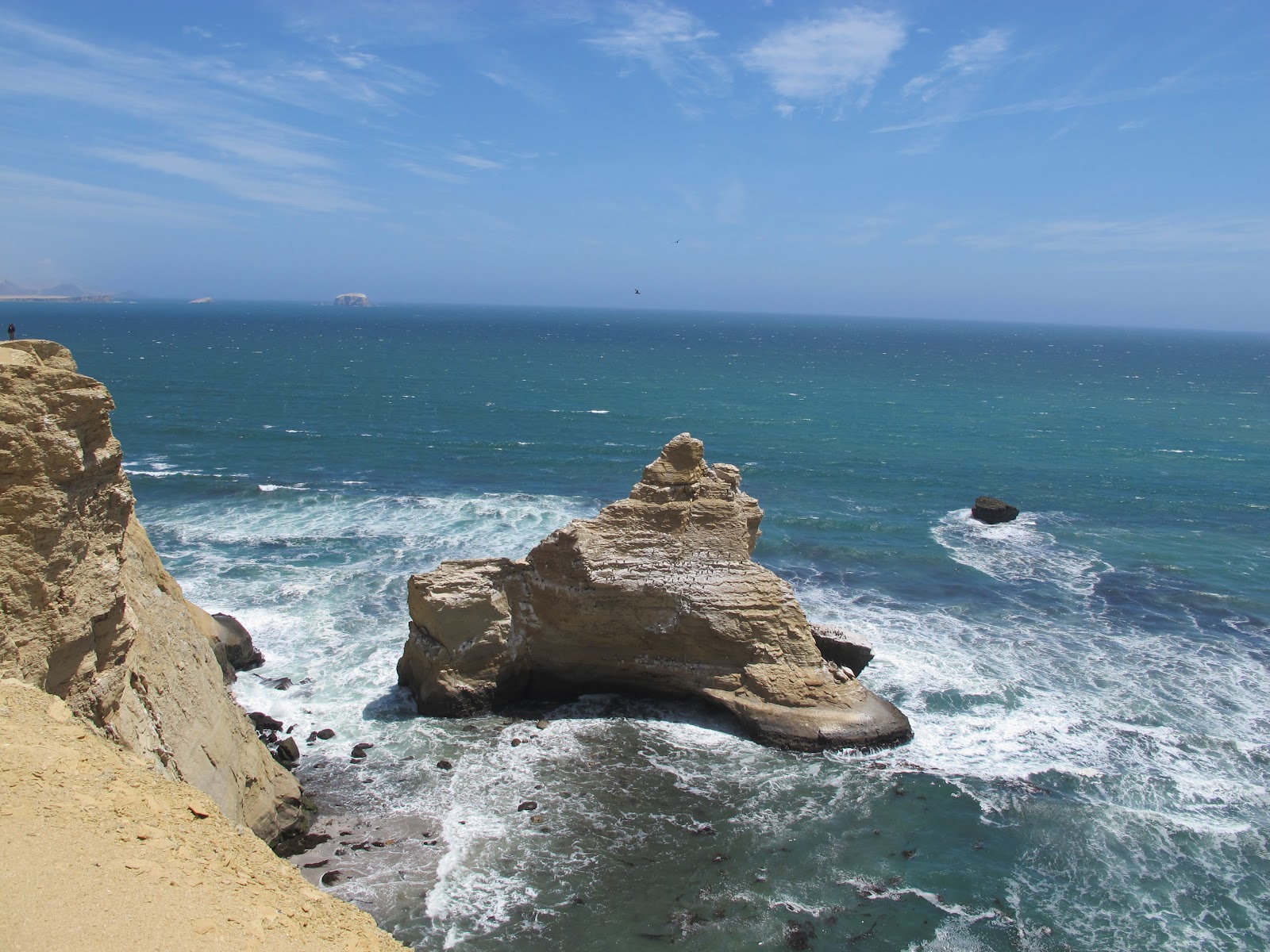
From there the bus continued further south to the windswept lookout from which one can see the rock formation called the "Cathedral".  The middle section of the formation collapsed during the 2007 earthquake that also, rather more importantly, destroyed a large part of Pisco, the largest town nearby.  Among the buildings demolished was the real Cathedral, which collapsed on those celebrating mass at the time.  The town is still far from recovery.

The Cathedral before the earthquake
The Cathedral today
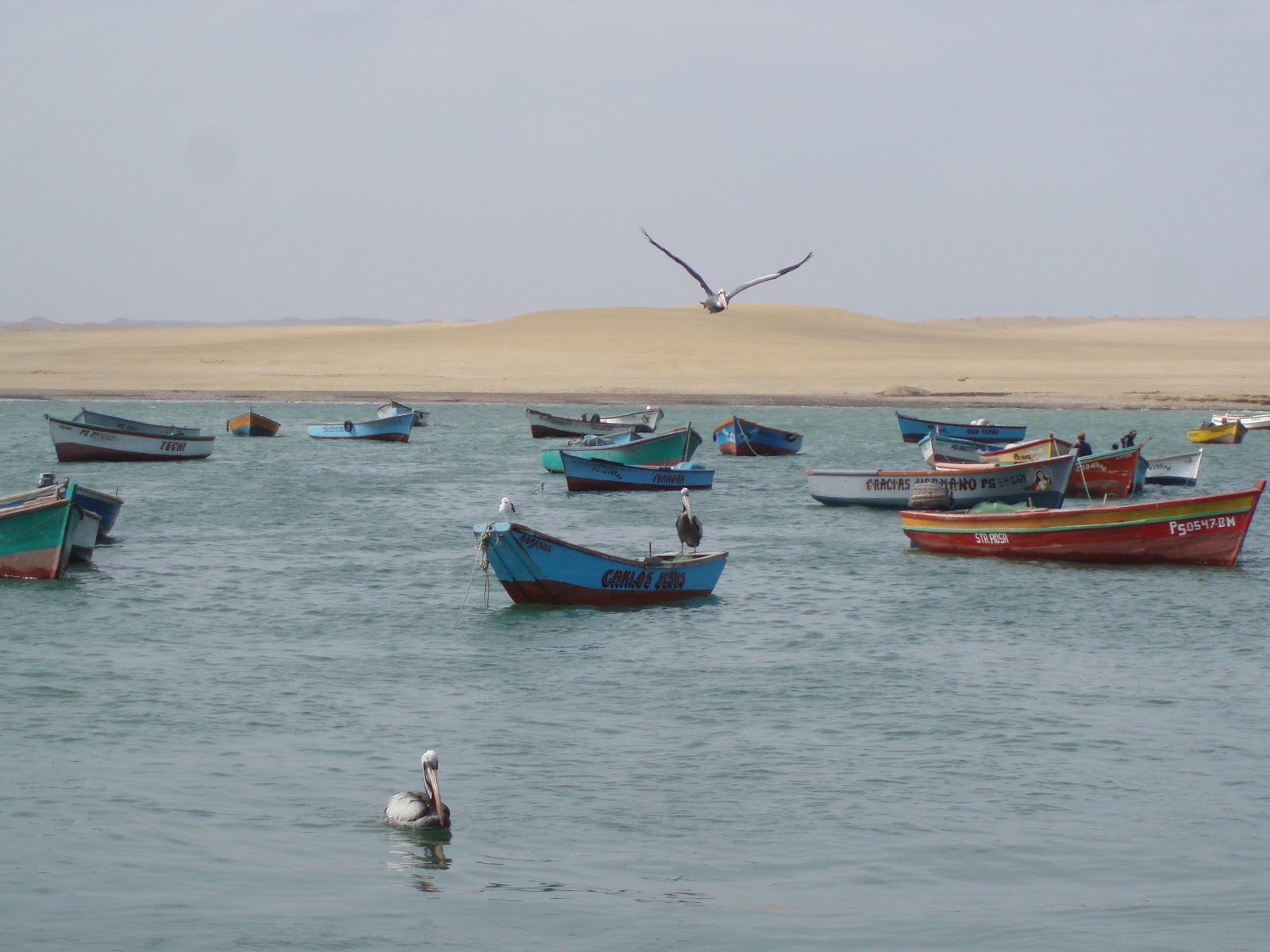
After another brief stop to take in the view over Yumanque beach (and, for me in my shorts and sandals, to brave the bitingly cold wind), the bus took us further into the peninsula.  We had lunch at a small fishing village called Lagunillas, where we tried for the first time the Peruvian speciality of ceviche.  This dish of very lightly cured fish was followed by deliciously fresh grilled fish.  After lunch we hopped on the bus for the short journey back to Paracas.


Pelicans looking for fish at Lagunillas harbour

More pelicans
In the afternoon we investigated a small museum a couple of doors down from our hostel.  It consisted of only two small rooms, but had a well-chosen selection of ceramics, textiles, and deformed skulls from each of the main cultures that had occupied the region in the two millenia before the Spanish arrived.  It's a private museum opened recently by a local expert, Juan Navarro Hierro, and has already had to survive one break-in.  It's not mentioned in the guidebook, but should be.  The visit was greatly enlivened by explanations from a Canadian archaeologist who had been working down in Peru for the last five years.  Together with the more traditional explanations, he told us about his hypothesis that some of the stonework attributed to the Incas is so incredibly sophisticated (cut with greater precision than a laser could manage) that it must have been the work of some lost culture.

After a walk along the beach and a close encounter with some friendly pelicans frolicking by the shore at dusk, we stopped for a Pisco sour on a terracing overlooking the ocean.  We concluded the day with dinner at a small hut just off the beach, where the fish was again wonderfully fresh.

Pelicans on Paracas beach
---

We woke early for our boat tour to las Islas Ballestas, which was the reason for stopping off at Paracas on the way to Lima.  Since we'd decided to leave the Galapagos for another time, this was to be our taste of Pacific Ocean wildlife (the islands are also known, rather unflatteringly, as the poor man's Galapagos).

We arrived at the small harbour and joined lines of tourists to climb into speed boats with 30 souls on board.  Thankfully we were among the first to set off, so the water wasn't too crowded, and we were usually moving onto the next part by the time the hordes arrived.

On the way to las Islas, we paused to admire the Candelabra/Cactus (looks much more like a cactus to me), which is thought to have been created by the Paracas culture more than 1500 years ago and has survived in the compacted sand due to the lack of rain.


The three small Ballestas islands, around 30 minutes from shore, are occupied by vast swathes of cormorants, dozens of sea lions sprawled lazily in the morning sun, and a smattering of much more reclusive Humboldt penguins.  Atop the islands we could see the guano harvest, an exercise conducted every seven years to collect (pitchfork by pitchfork) the enormous amounts of guano (known to most as bird poo), which is a very valuable fertilizer shipped all over the world.  Astonishingly, in the early part of the 20th century guano accounted for almost 90% of the value of Peru's exports (or even its GDP, it wasn't clear).  The country was then plunged into an economic crisis when it emerged that they were shipping the stuff out faster than the birds could poo, and eventually their reserves were depleted.  This very smelly resource is now, thankfully, managed rather more sensibly.

Arriving at las Islas

Cormorants and pelicans

Humboldt penguins

Sunbathing sea lions

The guano harvest

After around 45 minutes of cruising among the wildlife, and with our cameras full, it was time to head back to shore.  We arrived back at around 10.15, just in time to catch the bus on to Lima.

Friday, October 14, 2011

6th-7th October: Colca Canyon and Arequipa

The alarm went off at 2.55am.  We were out the door by 3.15, and on the minibus to Colca Canyon at 3.30.  This was softened somewhat by being provided with blankets and neck-pillows, and we managed to doze for the three-hour journey to Chivay.  Through sleepy eyes we saw the sun rise over the mountains; then we closed them again.  After some entertaining incompetence from the agency at the tourist checkpoint (buying everyone's pass was a bit too complicated, apparently), we stopped off for breakfast before heading into the canyon.

By this point I was getting mildly agitated to get on with it.  Thankfully the driver shared my sense of urgency, and we whizzed past several other tourist-laden minibuses on a bumpy gravel road with the canyon tumbling down to our right (at least he overtook on the inside).  After an exciting half-hour or so we arrived at Cruz del Condor, its cliffs and cross-bearing rocky outcrop already lined with tourists, trigger fingers at the ready.  We piled out of the minibus with 40 minutes to enjoy the condors.  At first, we saw none.  Then Clem did her Condor dance (a little bit like the "funky chicken", I suppose) and, not long after she was told to stop, the huge birds were swooping down on us.  They soared up on thermals, cruised nonchalantly past us, and swept down into the canyon below.  More and more emerged until there were almost a dozen circling over our heads, spiraling down until only a couple of metres above us before gliding off to another part of the canyon.


See any condors?


Last one, promise (we'll spare you the video)
After we'd sated our cameras, we hopped back in the minibus to make our way another half-hour down the road on the way to Cabanaconde.  When the town was in sight, we pulled over and jumped out, and we were divided into those doing the three-day trek (not us) and those doing the two-day trek (us, plus five French girls, a French-Canadian couple, and a Korean guy).  We quickly realised that our guide was a bit of a loon when he declared, "Your hotel may have told you it takes four hours to get to the lunch stop, but that's because the other guides stop and tell you about the canyon.  I'll save that for later, so we'll do it in two hours.  But you must focus on the trekking.  Focus!"  With that, he loped off down into the canyon, while I was still lacing my boots.

It turned out that his idea of "focused trekking" basically involved running down the mountain.  We just about managed to keep up, and we did indeed make it down to lunch in two hours.  We went down to the deepest part of the canyon, at around 3300m the second deepest in the world (the deepest is also in Peru, called Cotahuasi Canyon), and then had a climb of around 10 minutes back up to lunch.  This included a stretch that had us scrambling up rocks with a drop back down to the creek, all of which Clem very much enjoyed.

The Oasis at the bottom of the canyon, the end of the first day
Clem looking excited about the path ahead
Our first target, the river at the bottom of the canyon, looks a long way off
Bridge at the bottom of the canyon, after much "focused trekking"
Fun little climb back up the other side
Lunch was decent, a filling vegetable soup followed by strips of alpaca meat with rice and chips.  After five minutes of digestion time, our slightly loopy guide (who evidently had a date to meet down in the Oasis at the end of the day) led us back up the other side of the canyon.  This half-hour climb wouldn't have been much fun with an empty stomach, but it was even tougher with the alpaca still cavorting in our bellies.  Nevertheless, we and our lunch made it to the top of that stretch, and after a short rest (and a powerade purchase) we set off on a more gentle stretch, running alongside the canyon.

After an hour or so of fairly flat going through the arid canyon, visiting a couple of small villages (the reason Clem had bullied me into doing another trek only just after the Inca Trail), the path turned down to the depths of the canyon again.  Here we crossed the creek on a bouncy bridge (slightly too bouncy for Clem's liking), then climbed up another ten minutes until we reached "the Oasis".  As its name would suggest, this is a leafy contrast to the rest of the canyon, nourished by a stream coming down the side of the canyon.  This same stream is channeled into a swimming pool, and after being directed to our bungalow we changed into our swimsuits and hopped into the pleasantly warm water.  Standing under the waterfall quickly washed away the morning's exertions.  After a warm shower in water that had been heated naturally, we enjoyed the rest of the afternoon sun before it slipped behind the top of the canyon.

Looking back up to the sheer face of the canyon
The church in one of the very small villages we passed through

View of the Oasis (and, ominously, the path back up the following morning)

The bouncy bridge leading to the Oasis (with wind attacking my hat)
View from the bridge
The swimming pool at the Oasis
Our cabin, as the shadows lengthen over the canyon
The cabin was very basic, adobe walls with a bamboo and thatch roof (with plenty of gaps for creepy-crawlies), and the spiderwebs in the corner over the bed quickly caught Clem's attention.  Our guide assured us that there were no spiders, but that we should be careful for mozzies (which turned out to be midges).

Our ever-communicative guide, who never did get around to telling us anything about the canyon, hadn't told us when dinner was either.  Luckily, however, we managed to wander out of our bungalow at the right time and find where dinner was being served.  We were then tucked up in bed by around 8, ready for a 5.30am wake-up and 6am start.

After waking to discover that we had not been savaged by deadly spiders, we shared a twix for pre-breakfast and set off for the steep ascent up to breakfast in Cabanaconde.  The guide had done his best to portray this climb back up the canyon as akin to summitting Everest, and had thereby convinced the five French girls to ride mules up instead of walking.  We resisted this not insignificant temptation, and plodded up the slope ourselves.  It wasn't unbearably steep, but what made it difficult was its monotony, at least compared to the Inca Trail.  The path wound from left to right and back again, ten or twenty metres at a time, with no natural breaks other than having to scramble to find a mountain-side perch as mules came past from above and below.  The scenery was, however, stunning, and we did manage occasionally to find time to absorb it properly (and capture it on camera).  We later heard that one of the mules carrying the French girls had knocked into a trekker who had stupidly waited on the wrong side of the path, and she had only been saved from a quick fall back to the Oasis by an outstretched French hand.

The French girls preparing to saddle up

Looking back down

We'd been told by our guide - with unreasonable urgency as usual - that it was a three- to four-hour trek, so we'd have to rush if we were to finish in time for breakfast at 9.  No stopwatch, however, beats faster than the remorseless pace of a determined Brosses.  Even with my calling from behind for brief breaks, we made it to the top in two hours, at around the same time as the French-Canadians and Boh, the Korean guy.  The French-Canadian couple, who looked like they lived in the gym, had been so spooked by the guide that they'd set off early lest they miss breakfast.

At the top of the canyon we paused for breath, photos, and bananas.  We could see Cabanaconde just a little further on, but of our guide there was no sign.  He'd passed us earlier, with the French girls on mules, without giving us a hint as to where to go for breakfast.  Assuming he'd be waiting for us at a convenient point, the five of us set off on the path to Cabanaconde.  We arrived at the town plaza without having found our guide, and started asking around for him at the various restaurants that looked like they catered to tourists.  After almost half an hour, as my rage levels started to rise, he showed up without apology and led us to breakfast.

Just about still standing after we'd reached the edge of the canyon
After sating ourselves on egg, bread, and coca leaves, we were picked up by the minibus and set off back towards Chivay.  On the way we stopped off at several viewpoints over the canyon, as our guide pointed out tombs in the mountain-side above us.  Our final stop before lunch was at the Chivay hot baths.  Clem wasn't overly impressed and stuck to the shower, but I needed a more rigorous clean that only a soaking in pools of 39 degree (and slightly sulphur-tinged) water could offer.


View of the valley on the drive back to Chivay


Tombs above the road back to Chivay


Clem looks for companions offering better conversational skills
Lunch back in Chivay was the usual tourist buffet for 20 soles, but the food was pretty good and we certainly needed it as the baths had sapped the last of our energy.  Finally we rejoined the bus for the three-hour journey back to Arequipa, via a quick stop to view the volcanoes in the distance.

An optimistic dog outside the restaurant

Quick stop for volcano vistas on the way back to Arequipa

The minibus happened to drop us off just outside our favourite Peruvian creperie in the Alliance Francaise, so we took the opportunity to stop by for a delicious fruit juice and chicha (a purple concoction made from fermented maiz).  We then went back to the hotel to pick up our bags, order a Domino's pizza (only for reasons of time, of course), and take a taxi to the bus terminal.

Last sight of the Cathedral, with the volcano in the background
The journey itself was a bit of a nightmare.  The two-tier bus flung itself around corners with such abandon that it really did feel like we were tipping, and from the look of Clem's face it would have been a long tumble down from the sheer cliff face edging the road.  Despite the driver's best efforts, we finally made it safely to Paracas at around 9 the following morning.

4th-5th October: Cuzco and Arequipa

After catching up on sleep (it is luxury to sleep in a comfortable bed after 3 nights on air mattresses) and enjoying a good breakfast (homemade bread and jam), we went for a last tour around the city, although not really "frais et dispos."  Our mission for the day was to visit the Pachacuteq monument and the Inca ruins of Saqsayhuaman.

The monument displayed an interesting exhibition on Pachacuteq, the 9th Inca king.  Allegedly, he did not inherit the throne, but won it by successfully fighting the Chancas, a rival tribe, in the 15th century.  He started the significant expansion of the Inca Empire (later pursued by his son).  He is also credited with the construction of cities and monuments, and in particular Machu Picchu, Saqsayhuaman and Qoricancha (which was a very important temple at the time).  The top of the monument offered a great view over the city, including an unfinished monument of Pachacuteq not far from the one we were visiting (apparently, there was a political rivalry; once one was finished, the other was abandoned).

Pachacuteq monument (plus a food center sign, for some reason)

The second, unfinished Pachacuteq monument
It was really nice to meet with Donna and Adam (whom we met on the 3 day tour of the Uyuni salt flats) for lunch and to share our respective war stories from the Inca trail.  We all agreed that it had been a wonderful experience.

There are four Inca sites very close to the city of Cuzco. However, we decided to limit our visit to the most important, Saqsayhuaman.  This large temple complex allegedly forms the head of the puma, the body of which is represented by the city.  Some of the walls contained huge stones, which made moving them an incredible achievement.  The site is greatly depleted from its original state, as some of the stones were taken by Spanish colonists to build their houses.  Apparently, the site still plays an important role; local people still worship Pachamama on the ritual tables at the top of the hill.

Looking small inside one of the huge gateways

The walls, several metres high, were constructed from huge chunks of limestone 

The womb-shaped hill where Pachamama (fertile mother earth) is still worshiped

Fossils in the limestone from which Sacsayhuaman is built

View of Cuzco's Plaza de Armas from Sacsayhuaman
Back at the hotel, we had a relaxing time in the café catching up on the blog and organising the rest of the travel.  A few hours later, we went to the bus station to catch our luxurious Cruz del Sur Cruzero Suite bus.  The seats were fully-reclining, which does make a difference on a 10-hour night bus.  However, service was a bit poor (we only had a sandwich for dinner...).  An enjoyable feature was the careful driving: no brusque movements.

------

It was six o'clock when we arrived in Arequipa.  The taxi dropped us at the hotel (thankfully we had called the previous day to confirm our online booking; apparently the hotel had moved...).  The lady who welcomed us was friendly and helpful and, even better, our room was ready and we could check-in.  After a few additional hours of sleep, we had breakfast at the café by the Alliance Française.  John had croissants, while I opted for the more reasonable yogurt with fruits and muesli (indeed, the name croissant brings high expectations - and although really nice, they were not real French croissants).

The center of the city where we strolled around was characterized by nice colonial-style buildings, mostly in the grey volcanic stone for which Arequipa is called the White City.  The Cathedral dominated the Plaza de Armas.  It was destroyed by several succesive earthquakes (the latest being in 2001) and was each time re-built.

Arequipa's Cathedral, in the Plaza de Armas
Re-energised, we took a tour around the Convento de Santa Catalina, spread around 20,000 m2, whose construction was financed in the 16th century by a wealthy Spanish widow.  Nuns lived in separate houses (composed of a major room and a kitchen at the back) with their servants, received musicians, and organised parties, until the Dominican order took over and tightened the rules (from then on, they lived in communal rooms).  At its peak, it housed 450 people.  Strolling along the streets of the convent named after Spanish cities, we saw the shooting of a Peruvian films, with actresses dressed in traditional Dominican habits.  Around 20 nuns still live in the modern part of the convent, the rest has been open to the public since 1970.

A courtyard inside the convent

Lights, camera, action...

One of the convent's long passageways named after Spanish cities

A nun's room (before they were moved into communal dorms)

View of the church from inside the convent
View from the convent of volcanoes overlooking Arequipa
Later in the afternoon, after buying John a nice jumper made from baby alpaca wool ready for the cold of Patagonia, we went back to the hostel for a nap.

In the evening, we went to a really nice restaurant serving "alpandino" fusion food, a mix between Andean and French Alps cuisine, called Zigzag (mentioned in the splurge section of the LP).  We were not hungry enough to go for the popular Alpaca steak sizzling on a hot volcanic stone, but nevertheless enjoyed a plateau of cured Alpaca meat, saucisson, and Andean cheese.  I also really enjoyed the Quinoa salad that came next, served with an original mix of fruits and vegetables.

We then packed small bags for the trek and went to bed early to be ready for the 2:55 am réveil.