We had planned to begin the month with a trip to Colonia, in Uruguay, but the thought of 6 hours' transport (a three-hour ferry journey each way) for the sake of a few hours in the town put us off. We'll save Uruguay for another trip. Instead, we decided to spend our penultimate day in South America in BA.
After a morning dedicated to errands, we had lunch in a charming little San Telmo cafe called La Poesie. We then took the bus to La Boca, a blue-collar neighbourhood down by the docks (or more precisely, to the few touristy blocks called El Caminito). The bus fare had to be paid in coins and we were short by around AR$ 0.40, i.e., not very much. We asked the bus driver to drop us at the next stop where we hoped we could get some change. He then asked people on the bus whether any of them had change for a $2 note, and instead a girl generously offered to pay our fare with her card. We wanted to give her what we had but she declined. This definitely spared us some hassle and we thanked her heartily.
15 minutes later all the tourists got off the bus at the stop "El Caminito". The street is famous for its painted houses. Originally, Italian immigrants lived in that area and they used to build and paint their houses using the unused materials that they found in the docks. The area was later abandoned and the houses lost their colour, but in the 1950s an Argentinian artist decided to recreate the atmosphere by painting the houses of one of the streets closed to the docking area, and it caught on. For more information click here.
The painted houses of La Boca
The street was definitely very charming, but very touristy and it would have been better appreciated without the horde of touts. On the positive side, this also meant that there were plenty of souvenir shops selling Boca Juniors' (the local team) t-shirts and other accessories, paintings, postcards, CDs. John bought a Boca Juniors t-shirt and I chose a picture of tango dancers. The touristy area of La Boca was only two blocks long and two blocks wide, and it didn't take us long to walk around. We were told that the rest of La Boca was unsafe for tourists, so we took the bus back to the apartment.
In the evening, our last night in Buenos Aires, we cooked some empanadas. We bought the dough from the supermarket, which saved quite a lot of time and hassle, and filled them with vegetables, meat, and cheese. We also prepared a few with fruits (a compote of pear and apple, and blueberries). Although not traditional flavours, they were very tasty, and we should be able to prepare some when we are back in Europe.
Filling the pastry
Ready for the oven
Ready to eat, with a glass or two of Malbec
Our final day in BA flew by. The morning was taken up with packing. We then headed north again for a walk around Palermo, but this time (on a tip from Angela) we strolled around the slightly more "up-and-coming" area. We found a nice place to eat, with a table on the side of the street where we watched BA go by for the last time. Then it was time to head back to the flat, collect our stuff, and take a taxi to the airport for our flight to San Francisco.
We woke up a few hours earlier than our usual laid-back schedule. After a few months traveling around South America, it was great to be able to empty our backpacks and settle for 2 weeks. The apartment was very comfortable, and we made the most of it by enjoying a few lie-ins and spending some time in the morning planning our next steps.
We walked to the metro station, which was already bustling with people at 7 am, to catch the train to the Retiro train station, where we hopped on a 1-hour train to Tigre. All of it was very smooth and we arrived in Tigre much sooner than expected (around 8 am). The boat to the island we were going to would not be leaving before 9 am, so after buying the tickets (interestingly, the man behind the counter knew the place as "lo del Suizo", or "the Swiss guy's place" better than the actual address), we waited at a cafe.
The colectivo boat was a beautiful wooden vessel, full with residents and a few tourists. The skipper was skilfully manoeuvring the boat to drop passengers close to their homes' piers. The 45-minute ride was very pleasant, taking us through a few of the numerous Delta rivers. We could imagine the life of this community from looking at the houses, the Church and the school. On our arrival at "lo del Suizo", we were warmly greeted by Ana and Ralph.
Colectivo picking up locals from their home
Ana gave the six of us (we were joined by Swiss and Texan couples) a tour of the house, while Ralph finished preparing the breakfast. The place had a great history; it used to be the guest house of the ballroom next to it (now unfortunately decayed). Early in the century, it was a lively place and Ana showed us pictures of parties that took place there.
View of the old ballroom
The enthusiasm of our host was very contagious. She gave us a quick geographic lesson about the Delta and the location of their house. We realised how immense it was (third largest in the world, I think) as our journey from Tigre to the island was only a minuscule part of the Delta. It was also very interesting to learn that the formation of the Delta was only quite recent, and continued every day. It had first started to form only a few centuries ago through the accumulation of sediments coming from the mountains of the altiplano in the North of Argentina and in Bolivia (added to by construction materials dumped in the river). It used to be a dynamic area, the major economy being the cultivation of fruits, but they were destroyed in the 1950s by an important flood and the industry was transferred to another region (the north of Patagonia). Nowadays, only 10% of the houses belong to permanent residents, while the majority are only inhabited on the weekends or during holidays. People on the islands mainly work as gardeners, housekeepers or teachers. The town is only a boat ride away, but in addition a few so-called "supermarket" boats come several days a week.
It was then time for breakfast. Ralph brought us home-made bread baked in the huge brick oven that once belonged to the restaurant of the ballroom. They had also managed to keep an old, wood-panelled refrigerator. The delicious bread was served with aubergine jam, honey, and dulce de leche.
We then embarked on the charming wooden motor boat for a cruise on the nearby rivers. As we were sailing, Ana was telling us about the local flora and fauna. We spotted some herons, a kingfisher that flew in front of us for a while, and some other birds. Apparently, small turtles, huge rodents, and swimming deer also inhabit the Delta, but we did not see any of them. After sailing along narrow rivers full of water grass and joncs, we arrived at the Rio Parana, a very wide river that large cargo ships can use to reach Rosario, the export hub for Argentina's greatest export, soya bean. The river is quite shallow due to the deposit of sediments, so large ships have to keep to the centre of the river, which is continually dredged.
View from the boat
The nest of a hornero, Argentina's national bird
Stand-off without much room for manoeuvre; the other guy yielded, thankfully
Lunch was served on the side of a narrow river, in a very quiet setting. We enjoyed a glass of Malbec while Ana set up the table and Ralph started cooking. As a starter, we were offered a tasty salad and were asked to help ourselves from among the many tasty appetizers: empanadas; a delicious curried butternut squash tart; fresh vegetables; and cheese (morbier or goat cheese from Cordoba) on a wooden stick with olives and sauces. Then Ralph served us some chicken which was very tener and melted in the mouth. We did thankfully have a bit of room left for the tasty and very juicy beef. For dessert, Ralph had prepared pana cotta with orange marmalade. It was a delicious and gargantuan lunch. Thankfully, we had been warned and had skipped breakfast at home in the morning.
Ana and Ralph preparing lunch
The aperitif
John in the lovely fleece he was loaned
Pana cotta with orange marmalade
Fish eating the bread we threw from the boat
After lunch, we continued our journey through narrow rivers, admiring the surroundings and enjoying the tranquility of the backwaters. There was not another tourist is sight, the delta was empty apart from us and a few locals. On the way back, Ralph dropped us a few hundred metres before reaching the house and we finished the tour on foot. Ana showed us the remains of the ball room that they had started renovating and their impressive bamboo forest.
Pretty house in traditional style
Back at the house, Ralph had prepared some delicious ice-cream with surprising flavours: ginger & wasabi, and mate herbs. He had also baked a nutty version of the traditional Alsatian kouglof. We sat outside and shared Argentinian mate with Ana, Ralph and the rest of the group. It was very convivial and we shared a few stories of our travels in Patagonia. We were also visited by a humming bird, which was drinking the sweetened water that Ana had just poured in jar on the tree.
Tea time with kouglof
Greedy humming bird
Unfortunately, time had flown by and at around 6pm we took a private taxi-boat back to Tigre. On the way back we noticed that the level of the water had increased significantly and that it was being swept on people's properties by the waves coming from boats.
High level of water
For some reason we thought that taking the bus back to BA would be more fun than taking the train. It was definitely an adventure: it took us about 2h30 to reach Plaza Constitution (10min from the flat); the bus was stopping every 2 blocks. Back at the apartment, we cooked some vegetables and had an interesting conversation with Romana (also staying in the apartment) before collapsing in bed.
First task of the day was to stop by the Indian embassy to collect our passports, hopefully containing visas. We had a slight scare when the Indian official (watching the India-West Indies cricket on the computer screen opposite us) said that Clem's passport had arrived but not mine. After a quick search, however, he found both and all was well. Reunited with our passports, we went for a stroll around town to complete the errands that had been frustrated by the public holiday the previous day.
We came back to the flat to chill out and work on the blog, before treating ourselves to BA's finest steak (on a tip from Chris) at Cabana Las Lilas. This restaurant is on the redeveloped waterfront of Puerto Madero, and is a little touristy, but the steak was indeed outstanding. I kept it simple with a bife de chorizo, while Clem went for the ojo de bife (and managed to fend off my fork to eat some of it herself). A good bottle of red to top it off and we went home feeling very well-fed, albeit considerably poorer.
In the morning we went up to Retiro and Recoleta in search for a present for a friend. We realised after trying a few closed shops that it was a bank holiday. Tough luck! We therefore walked further to Puerto Madero, where we stopped for lunch in a little cafe. We then headed to the Ecological Reserve Costanera Sur. There were plenty of people and it is obviously a popular place on the weekend (and holidays). After a quick look at the map, we decided to walk rather than cycle as it seemed that it would take only a couple of hours to walk around the Reserve. The marsh land comprising the Reserve originated from a 1970s project to reclaim land from the Rio de la Plata. This project was later abandoned but they continued pouring in land-fill and debris until 1984. From then on various plants took over the area, which later attracted birds and other animals. This area was later officially protected as a natural reserve.
View over Rio de la Plata from the edge of the reserve
We had only just entered the reserve and were strolling looking at the flora around us when a huge iguana stormed out of a bush just a metre or so from John and ran past us. A man had tried to warn us but we did not really understand what he was saying. Unfortunately, it ran off too quickly for us to be able to catch him on camera. After that, I was paying a bit more attention to the bushes, but we did not see any other giant lizards.
About 1 hour away from the entrance, we started feeling the first drops of rain. We had been hoping for some rain to cool down the heat, but we were not particularly happy about the moment it had chosen. We did not have any rain gear with us. We tried getting some shelter from a tree, but it was not particularly successful so we decided to keep on walking, slightly faster, towards the nearest exit. The rain was not too heavy, luckily, but it was not quite enough to defeat the heat. By the time we exited the park, the rain had stopped and we thus decided to walk back to San Telmo, which took us about more than an hour.
Parakeets were plentiful (and stayed still longer than the iguana)
Back at the flat, we were pretty exhausted but we found some energy to register for a tango class that evening. We had found a little club in the information booklet prepared by Angela, which was only about 10 blocks from the apartment and offered tango classes on Mondays and Wednesdays. We had dinner and dressed up before heading to the bendita milonga.
Stairs to the main room
View from our table across to the bar before the start of the class
The class started a bit after 9pm, which gave us time to buy a bottle of wine to help us relax. The teachers showed us a couple of moves, which were not that easy to replicate. We did our best and enjoyed it a lot but quickly realised that we were probably the worst dancers, or the only real beginners. We enquired about private classes, but unfortunately the teachers were booked up (and moreover, we had quite a busy schedule for the next couple of days) so we thought we might try in London instead.
Around 11pm, the orchestra El Afronte started playing and the dance floor filled up with good dancers. I don't know if it was the wine, the cheerful atmosphere or a combination of various elements (dim light, beautiful dresses, and the enthusiastic orchestra) but I really enjoyed watching the dancers and seriously considered learning tango.
The band El Afronte (video below)
About 1h30 later, a couple of professional dancers performed more acrobatic tango, and had the whole room very impressed. We left soon after that, as it was well past our bedtime.
Our Sunday's entertainment was to venture out into the suburbs of BA for the Feria de Mataderos. After a more moderate breakfast that the previous Sunday's seven-course feast, we took a taxi out to Mataderos, which was about a 45 minute drive from San Telmo. We had grappled with BA's complex bus system, but eventually we gave up and took the considerably more expensive option of cabbing it.
Feria sign in front of the gaucho statue in the middle of the square
We arrived to find a large number of market stalls stretching out from the main square. The stalls that we walked past first were mostly selling touristy tat, and we feared (or at least I did) that this was not a great idea. As is customary, we sought consolation in food, and quickly perked up. We tried a few local dishes from one of the stalls: a humita, which is a kind of corn-mash steamed in leaves; meat empanadas; a traditional style lamb stew; and some sweet red wine. Very tasty indeed. The empanadas were being prepared in front of us, which left Clem eagerly planning to try her hand at the recipe.
Next to us was an impressively large open-air parilla, which was regularly topped up with fuel. We planned to try the meat but somehow never got around to doing so.
Some traditional local snacks
BBQ Argentina-style
By this time some music was playing from a stage in the middle of the square, but there was no sign of the folk-dancing we had been promised. We decided to wait it out, so passed by another line of stalls. These were much more interesting, because they were selling food and drink. We tried a couple of sips of wine (of which the sweet varieties were much better than the dry) and bought a variety of seeds that promised extravagant health benefits. We also purchased some beeswax straight from the hive, from which we were told to suck out the honey before spitting out the wax leftover. Very wholesome, although biting too much into the wax was not particularly pleasant. Finally, giving in to the midday heat, we stopped off for some ice-cream. This time I persuaded Clem to share...
After satisfying our tastebuds it was time for some dancing. Not by us, thankfully, but by some locals dressed in traditional garb, sauntering around to slightly-too-loud music blaring from speakers on the stage. More amusingly, they were then joined by locals from the crowd, not dressed up at all, who just seemed to fancy a dance. This went on for a while. At the end of each song some dancers would melt back into the crowd, and others would join. Partner swapping was standard. Just a neighbourhood dance on a Sunday afternoon (with a few dozens tourists taking photos, of course).
Dancing in the street (and video below)
This amateur folk-dancing was followed by a session from a more professional outfit, a troupe visiting from Salta. Their dances revolved around a girl dressed up as the devil, whom they seemed to be dancing with and then smothering, while the MC (in gaucho dress) whooped and hollered on the microphone.
Dancing with the Devil
After a hour or so of dancing, the early afternoon heat was starting to get the better of us, so we decided to head back into the centre. After an amusing game of find-the-right-bus, which obviously entertained the bus drivers who sent us off in the wrong direction, we found a bus headed back to the centre of BA, which took us about an hour. There I found a sports bar showing the second half of the NFL game, which Clem very gamely sat through (especially because the American kids next to us were unsurprisingly loud).
After the Falcons' glorious victory we walked back south to San Telmo and spent the rest of the evening relaxing and enjoying another culinary masterpiece from Clem.
Thanks to our shopping expedition of the previous afternoon, John was the proud owner of two polo shirts, a pair of chinos, and some deck shoes: a perfect Argentine look! We thought that the backpacker outfit (old tee-shirt, large trousers, and walking shoes) would not be fit to go dancing tango or to go watch a polo game.
After a quick lunch, we went downtown to buy polo and football tickets for the next day. Thankfully the retailers were not far from each other. The polo tickets were sold at a place selling tickets for lots of different shows. We went for the cheapest option (i.e., the stands facing the main ones). Buying football tickets was slightly more fun as it involved going to one of the team's official shop. A little sign on the door warned us that this was serious business: you were not allowed to enter wearing the jersey of a competing team. Boca Juniors, leader of the first league, was not playing that weekend so we went for the match between Racing and Belgrano (from Cordoba). We found the Racing shop to buy tickets, and the guy in the shop was very pleased to see us. He enthusiastically explained the different types of tickets, and recommended the main stand (away from the ultras but still plenty of atmosphere).
After successfully concluding our shopping expedition we walked towards the neighbourhood of Recoleta for the "Gallery Night" event. This involved 70 galleries opening their doors from 7pm until 11pm and (most importantly) offering glasses of champagne and cups of Nespresso; a rather civilised way to spend our Friday evening. We saw that a talk had been organised at 7pm, so thought that it would be a short "kick-off" speech. It turned out to be a full-scale conference, which didn't seem particularly appealing (especially to John, given that it would be in Spanish). We managed to sneak out just before it started.
A little further down the road we found something much more interesting at the Musuem of Latin American Art. In a beautiful room decorated with colonial-era art (including some from the Cuzco school, our favourite) and Potosi silver, we were entertained by an excellent performance by a Polish violinist and a woman accompanying him on the piano. We stayed until the interval and then dragged ourselves away. We could happily have stayed, but decided that the idea of the evening was to try lots of different events.
The next place we visited was an open air gallery with some striking modern art. Here we were treated to our first free glass of "Chandon" champagne. Over the road the Fiat showroom had been turned into a gallery for paintings and photos of bright red Ferraris and other sports cars. We were served more champagne by the waitress/models.
In total we went to around 10 galleries. One of these sold clothes made from recycled nylon and other materials. Our favourite was definitely the gallery that exhibited only photos of cows. Very Argentinian. The best setting was probably the Park Hyatt hotel, in an old palace on Avenida Alvear, where they had a exhibit of painted paper (washi) lampshades (Japanese style) which were pretty but not tremendously exciting.
After a couple more glasses of champagne we hopped in a taxi to the restaurant in Palermo Viejo where we had made a reservation. It was advertised as a "cocina de autor". Unfortunately it had moved and the lack of directions from the woman to whom I spoke on the phone meant that we wandered around for some time without managing to find it. Eventually we settled for somewhere else. Sadly it failed to live up to its name: "Lo de Jesus".
26th November
Our late night in Palermo was followed by a late réveil, and we had lunch at home before heading over to the Campamento de Polo in Palermo. Since the lack of space in our rucksacks had limited our ability to carry proper clothes, and because we were heading to the football directly afterwards, we were not dressed as well as we would have wanted. Thankfully, and to my great surprise, nobody else was properly dressed, except for a few older people.
When we arrived, the first match (the least important) had already started on the field outside the stadium (a bit like the nursery ground at Lords cricket ground, John told me). We found a space under the shade to watch. I was very impressed by the beauty and strength of the horses, although it was difficult to appreciate the game properly from the meadow beside the field because we did not have a great vantage point. People-watching was also fun, especially as there were lots of spectators who showed the signs of cosmetic surgery. It was probably more exciting for John, as many ladies were wearing short skirts.
The main game took place on the field in front of the main stand. Our (cheaper) tickets were for the stand facing the main stand; this was also facing the sun, which was a pleasure for the moderate period that we stayed but might have become draining after a while. This also meant that we had to leave the ground and enter again the other side, which was slightly tedious but not too inconvenient. It was much easier to watch the game from the stand. The Delfina team was clearly dominating Pilara. We left after a couple of chukkas (periods of play) as we had to make our way over to the football stadium.
The main attraction
Horses being cooled off with moist air
We had planned to take a taxi, but the first taxi driver we found told us that it would be seriously expensive. We asked if there was a bus that would take us instead, and he dropped us at the right bus stop. There was a young couple of the bus sporting Racing's colours, so we got off at the same stop as them and made our way over to the stadium. There the smell of grilled burgers was very tempting but we managed to resist. Not that our pack of cookies was much healthier!
We arrived around 45 minutes before kick-off and the atmosphere was already great. The ultras (hardcore fans) were off to our left and their section was already full and making plenty of noise. Our stand was also full, and we were in the very tiny majority who were not wearing a Racing shirt (although we were at least in the right colour, blue). Off to our right were the away fans, also singing loudly, netted in to prevent them from throwing flares or coins down onto the pitch. The pitch was surrounded by a moat, presumably to prevent the crowd from rushing on.
Ultras behind the goal. The Belgrano goalkeeper was hit by something only five minutes into the game
Shortly after 7pm (once they had managed to inflate the tunnel for the players to enter from beneath the moat), the crowds cheered and hissed the players onto the pitch.
Belgrano were dominating possession and took the lead midway through the first half. Three quarters of the stadium was in stunned silence while the scorer bunny-hopped into the corner and the away supporters screamed louder and jumped higher. When Belgrano doubled their lead a few minutes later we worried that our neighbours would go wild, as the stunned silence had been replaced by screams of anger, with some sweet words for the Belgrano supporters.
Racing then pulled a goal back when the lanky number 10 curled in a free kick. The crowds reaction was initially strangely muted, but after a few seconds the stadium filled with singing and screams. That didn't last long, as Belgrano scored a third just before half-time, as the bunny-hopper looped a header over the goalkeeper. Racing were booed off the pitch.
With around 25 minutes to go in the second half Belgrano had a man sent off, and Racing scored from the resulting freekick:
Despite the numerical advantage Racing didn't manage to create many chances, and the crowd grew impatient, but from our left the singing of the ultras remained loud. With a few minutes left we decided to escape, not wanting to have to try to find the bus stop back into town from the rough suburbs amid a mass of angry ultras. We later checked the score, and the game ended 3-2 to Belgrano.
We successfully beat the crowds and caught the bus, which very conveniently dropped us off right outside the restaurant we'd been planning to try. The entrée was excellent, grilled goat's cheese with aubergine and red pepper, but the salmon salad (drowning in lemon) and lamb cutlet (tough and dry) that we had for mains were fairly disappointing.
After another relaxing morning and lunch at the flat, we set out at around 1pm to take the metro up to Palermo. It was hot outside (> 30 degrees celsius) and even hotter on the metro; eventually we could bear it no longer so decided to get off and walk the rest of the way. After a pleasant half hour's stroll (clinging to the shade) we arrived at Plaza Italia.
Palermo is BA's trendiest area (at least for tourists; I'm sure it's not actually that cool any more). It's leafy and affluent, but not quite as traditional and, well, middle-aged as Recoleta. Above all, Palermo has lots and lots of shopping, mostly high-end.
Our first stop was the museum dedicated to Eva Peron (Evita), whose extrovert personality dominated Argentina from the 1940s until her death in 1952. The personality cult recorded by and reflected in the museum was frankly rather disturbing, but it was nevertheless an interesting insight and well worth the visit.
We then walked past the BA zoo and botanical park towards the Japanese gardens, but these were closed. Not to be denied, we continued on to the rose gardens, which were thankfully open. There we settled on a bench to enjoy the early evening light reflecting on the small lake at the edge of the park, until we were eventually evicted at closing time.
Taking it easy in the rose gardens
Gardens in the heart of the city
From the rose gardens we strolled around the park, dodging runners, cyclists, and lycra-clad rollerbladers, and back into Palermo Viejo, the main shopping area. We weren't looking to buy anything, not least because most of the shops were beyond our travellers' budget, but we were almost overwhelmed by the sheer density and variety of the shops on offer.
In the evening we treated ourselves to a highly recommended parilla, Don Julio. It was only a Tuesday night, and relatively early by Latin standards, but the place was packed. Our grilled provolone starter, which we could see melting on the parilla, was great. I then had a bife de chorizo and Clem had a small version of the same cut (where "small" means "slightly less huge"), both of which were jugoso and delicious. The only disappointment was Clem's side dish, an avocado and pineapple salad that featured meagre slices of avocado surrounded by chunks of pineapple that had clearly been tipped straight out of a can. Nevertheless, it couldn't detract from the fantastic introduction to Buenos Aires steak (and served as a lesson to avoid any kind of salad).
23rd November
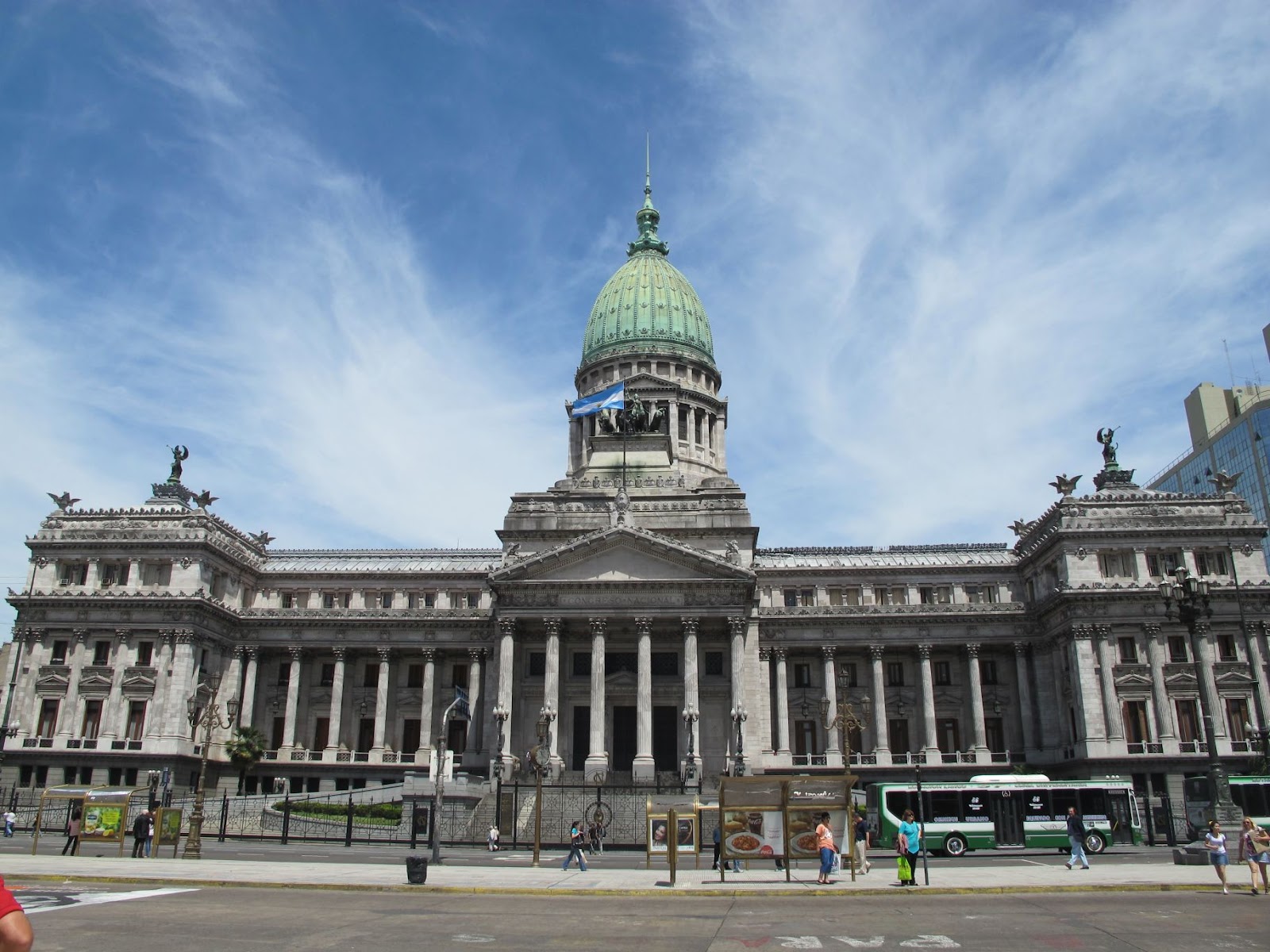
For once we managed to leave the apartment at a reasonable hour, catching the metro up to Plaza del Congreso, where we joined our second "free tour" of BA. This tour, run by the same company as the Retiro and Recoleta jaunt, stretched from Argentina's Congress building to the Casa Rosada and then up to the Plaza de la Republica.
Congreso
Our extremely enthusiastic guide again did a good job of keeping his large group of followers entertained (and together). Outside the Congresso he told us we could join a free tour of the building twice a day (from which we later profited) and pointed out on the corner a former government building that had been abandoned because the upkeep was unaffordable and had since been occupied by squatters. From there we walked along the Avenida de Mayo towards the Casa Rosada, across Avenida 9 de Julio, which was the widest boulevard in the world before being overtaken by a monster in Brasilia.
The (French-style) building lost to the squatters
Flamboyant architecture along the Avenida de Mayo
In front of the Casa Rosada we had a brief history lesson while sheltering in the shade, followed by an ice cream break. Thanks to Italian influence the ice cream in Argentina is pretty good and it was the perfect antidote to the sweltering heat. We then walked up the "Diagonal Norte" that runs northwest from the Casa Rosada to Plaza de la Republica. There stands the obelisk built in 1936 to commemorate the 400th anniversary of the founding of Buenos Aires, whose principal purpose now seems to be to serve as the centre of celebrations for football fans.
The sun surrounded by a halo of BA smog
Our guide also pointed out an amusing house perched atop a tall apartment block overlooking the Plaza; some guy who wanted to live closer to the centre of the city without living in a small flat, apparently. Bizarre. That was the end of the tour.
More idiosyncratic BA architecture
After a quick bite to eat we headed northwest to Recoleta and its famous cemetery. A funeral procession was entering at the same time as us, which left us feeling unsurprisingly sombre. Not so some of the tourists, whom we saw posing as zombies for photos in front of the spectacularly ornate tombs. These delightful folks did at least have one benefit; after wandering around the labyrinth for a while we eventually just followed the zombie conga line heading for Evita's tombstone. A quick peek was enough for us, and since it was starting to feel slightly creepy we decided to head back to the land of the living.
We walked back down through Recoleta and Retiro, along Avenida Santa Fe and Avenida Cordoba, doing a little window-shopping as we went. After three months on the road my t-shirts were either falling apart or unpleasantly discoloured, and my only footwear was hiking boots and some sandals that were last in fashion 50 years ago, so Clem had decided it was time to intervene. This initial browsing was, however, unfruitful, and we arrived back in San Telmo after a very long walk completely exhausted but empty-handed. We just about summoned up the energy to head back out to the supermarket to pick up food for dinner, and then collapsed.
24th November
Another lazy morning, catching up on sleep that had been lacking in Patagonia, was followed by an afternoon's shopping. This time it was rather more productive, and we both picked up some clothes to make us look slightly less like backpackers and more like real people. In the evening we ventured out to find a tango bar. The place we had been recommended didn't have anything on that night, but they did tell us that there was a tango festival starting the following week, and gave us some details. Since we'd made the effort to get out of the flat we decided that we owed ourselves a drink, and stopped off at a cocktail bar on Caseros. I went for the very masculine choice of a maracuja caipirinha, which was excellent, while Clem had a slightly underwhelming Cosmo (the best ever tasted so far was in a small bar in Brussels). By now it was way past our bed time so we retreated back to Piedras.
The flight from Ushuaia to Buenos Aires was relatively peaceful, albeit with some surprisingly timed entertainment. Take-off over the Beagle Channel and its icy gales was calm, but the storm that welcomed us to Buenos Aires made for a bumpy landing. The same storm had caused havoc with the taxis, but eventually the remise arrived and drove us into the city.
We were greeted at our home for the next two weeks by Angela, our American hostess. We would be staying in a lovely old house in San Telmo, where the high ceilings would spare us the worst of the incipient summer's heat. The house had been carved up into three double bedrooms, with two bathrooms, a large shared area with sofas and dining table, and a well-appointed kitchen. There was also a rooftop terrace, although we didn't get much use from it that rainy night.
As we arrived our fellow guests were having dinner: a young American couple and a pair of retired Australian women, all of whom were very pleasant. They had already been in BA for a few days, so were able to give us some useful tips, to which Angela added her own very valuable advice. We lingered for a generously-offered glass of vino tinto, then went for a wander to find dinner. By then it was past midnight, so we had been forcibly introduced to BA time. We found a decent bite to eat at a cool old diner called la Popular (decked out in red, appropriately enough). We then returned home for a much needed sleep.
------
20th November
We enjoyed a lazy Sunday morning, then strolled down the road towards the San Telmo fair. On the way we stopped off for an extraordinarily gluttonous brunch, comprising seven courses finished off with a champagne cocktail. We justified this as a celebration of our return to civilisation. We could barely move but struggled on.
The fair was spread out over a couple of kilometres of road from the bottom of San Telmo all the way into the centre of the city, but was focused around Plaza Dorrego, where there were numerous stalls and shops selling antiques. Elsewhere shops and street-vendors offered everything from clothes to food to useless knick-knacks. Amazingly we managed to emerge unscathed and unburdened by purchases.
The fair ended at Plaza de Mayo, named after the month in 1810 in which Argentina had its first national government. The plaza is dominated by the Casa Rosada, the Pink House, which is the Argentine equivalent of the White House. No sign of the recently re-elected Cristina. We did a tour of the plaza and then walked back down to San Telmo. We cooked ourselves dinner (which was rather more moderate than lunch), had a nice chat with the Australians, and then went to bed.
Casa Rosada
Plaza de Mayo (the protesters in the background are troops who
were trained for but never sent to the Falklands War, who want the social
security benefits to which they would be entitled as "war veterans")
------
21st November
Again we struggled to make it our of our comfortable bed. We had lunch in the apartment, then set out for the Indian embassy to apply for our visa. We thought it would be a good idea to deal with this immediately so we could get on with enjoying BA. It was lucky that we were, for once, well-organised: we were told that the visa would take eight days to process, leaving us very little grace before our flight to San Francisco and beyond. We had a slight detour via the embassy's former address, but once we did arrive we found it very pleasant. The embassy has a spacious waiting area with computers, wifi, coffee, and books of the highlights of India that really whetted our appetite.
We left the embassy at around 3.30pm, which gave us an hour or so to wander around before our "free tour" started. We strolled down to the Puerto Madero, the old dock which had been converted (like so many around the world, apparently) into expensive flats and offices. Moored opposite several touristy restaurants was the corvette "Uruguay", which we had read about in Ushuaia as the saviour of the Swedish expedition to Antarctica in the early 20th century (see previous post). We had a brief look around the ship, which was sturdy but not particularly large, and marvelled at what it must have been like to sail to Antarctica on such a vessel.
Aboard the "Uruguay"
We then walked across to Plaza San Martin, the start of our "free" tour around Retiro and Recoleta, traditionally the most wealthy parts of Buenos Aires. The tour was led by a very enthusiastic young woman who had set up the tours with a few friends several years ago. Judging by the number of tourists flocking around, the enterprise had been successful. The tour is theoretically free, but tips are expected and given, perhaps even more generously than if payment were demanded.
Statue of General San Martin
The two-hour tour passed by several huge and ornate palaces built by BA's super-rich during the boom years towards the end of the 19th and start of the 20th centuries. Clem was particularly impressed by the large buildings that not only looked Parisian but had in fact been shipped over from France slab by slab. Our guide explained that it was a question of ballast. The ships that carried Argentian beef over to Europe used to return to South America laden with immigrants. This human tide receded during WW1, but the ships still needed ballast, so building materials were a perfect substitute.
French style, French materials
The ubiquitous dog-walkers (and, bizarrely, an English postbox)
We also passed by a rather tense juxtaposition: on one side of the square was "Big Ben", a clocktower donated by BA's English community to celebrate Argentina's centenary; glaring at it from the other side of the plaza was a memorial to those that died in the war fought over the Atlantic rocks known as Las Malvinas or the Falklands.
On one side of the plaza...
...and on the other.
Franciscan church next to Recoleta cemetery
In the background is the mechanical flower that opens at dawn and closes at dusk (when it's working)
After the tour had finished we walked back down to Plaza San Martin and caught the metro down south to San Telmo. We walked the last few blocks along Defensa looking for a restaurant, and ended up at an old joint called Bar Hippopotamus. This started life as a grocery store in the 19th century, and then became a writers' haunt in the 20th century. Now it is a slightly touristy bar, which served up decent if rather greasy fare.
The bus to the national park (12km from Ushuaia) picked us up from the hostel at 10 a.m., which was very civilised: no need to rush or wake up early. There was a quick stop at the entrance of the park to pay the fee. We also got some useful information from the bus driver and the rangers as to which trails to choose. They advised us to hike the Guanaco trail instead of the Pampa Alta one, where the scenery would be similar to the walk that we had already envisaged doing along the bay. The bus dropped us at the pier in Ensenada Bay.
The sight of a few tourist buses had us slightly concerned that the path would be crowded. Thankfully, it was not; we only passed a few groups. At about halfway, we reached a quiet and pretty beach where we enjoyed a great view of Lapataia Bay. On our right, 20 meters from the sea, were the remains of a Yamana midden. The native Yamana used to dump their empty mussel shells and other rubbish outside of their tents. They would move on after a few days, but would go back to the same living area 6 months later and leave their rubbish at the same place. They would thus create a little mound on which the grass would grow. On our way we also spotted (after hearing) a very pretty Magellanic woodpecker, one of the emblems of the region but apparently quite rare.
Walking through woodland on the shore of the Beagle Channel
John with the Beagle Channel and Isla Navarino in the background
Mount Susana (especially for John's sister)
Standing by the shore of the Beagle Channel
Woody the Magellanic Woodpecker
Woody in action:
We stopped for lunch close to the visitors' center in the middle of the park. Our spot offered a great view over Lapataia River. We were welcomed by a few very cute rabbits (one of whom was then hit by a car speeding right in front of us; trop triste). We then walked to the beginning of the other trail, which was to lead us to a lookout on Roka Lake and surrounding mountains. After an easy 20-minute walk aroud the lake, we turned right onto the Guanaco trail. A signpost warned the visitors that the trail was closed. However, the park ranger had told us that we could go until the lookout halfway up the trail.
Rabbit before the speeding villain arrived
View from the lake up to the lookout point to which we would be hiking
After going up the steep slope for around an hour, we arrived at the lookout much sooner than we had expected. Our plan was to take the 5pm bus back to the hostel and we therefore thought we should hurry, so we nearly ran up the hill. No need, it turned out, but at least it was good exercise. The view on Roka Lake was beautiful and the effort was clearly worth it. We met only 2 people as we were going back; it was great to have the view for ourselves.
Arrived at the mirador
Once back down, we realised that we had more time than we thought before the bus and thus decided to walk to the other side of Lapataia Bay. The walk to the bay was very enjoyable as the landscapes were pretty and (more importantly) it was flat. We walked around a little island, crossing the Cormoranes Archipelago. It was lovely scenery but we did not see any cormorants. The lookout a few hundred metres further offered a great view over Lapataia Bay and the beginning of the Beagle Channel.
Walking through the archipelago
We eventually arrived at the end of the famous RN3 (the national road that runs along the east coast of Argentina from Buenos Aires all the way to the Beagle Channel, 3045 km in total). There were about 8 of us waiting for the bus, and we all stood up when we saw one arriving. Interestingly, none of us had the right ticket to hop on that bus. There are apparently 2 or 3 companies offering the exact same service, which did not seem very efficient.
End of the road!
For dinner, we cooked some fresh pasta with a mushroom cream sauce (made with Patagonian mushrooms and some beer), and some fine slices of parma ham on top. It was very tasty!
----------
17th November: Laguna Esmeralda
The LP recommended a popular easy half-day walk to a lake called Laguna Esmeralda. The name sounded promising and it would allow us to leave late morning and return early afternoon (we did not feel like walking a whole day). A bit before 12h, we started walking to the city centre to catch a taxi-bus to the beginning of the trail. The bus driver was a really outgoing and colourful character. He told us that you can eat beaver during some kind of festival in Ushuaia. It is apparently a very tasy white meat. He got us very interested but unfortunately the festival was not happening at the moment. He dropped us at the entrance of a husky sledding school, called Valle de los Lobos (or valley of the wolves). He told us to take our time and call him once we were back at the sledding school, assuring us that he would be there within the next half hour. He insisted that we should take our time, relax, that's how it goes in Tierra del Fuego.
This all sounded very good, and after being given a few directions by somebody from the school, we set off. We passed in front of the smelly but cute dogs. There were about 50 of them in a very small area. They all had a little blue plastic niche and were tied to a rope, which was sad to see but they did not seem to be badly treated. The trail was very well-marked, but was pretty boggy, which was not always very pleasant. We passed by a few dams, but no sign of any beaver, which are apparently sleeping until 5pm when they start working.
Beaver dam but no sign of the architects
View over the peat bogs
We arrived at Laguna Esmeralda very hungry. We found a spot quickly and enjoyed tasty sandwiches (parma ham, avocado and tomato) in front of the emerald-coloured lagoon. It is possible to keep on walking and reach the glacier overlooking the lake. We decided to have a look at the trail, but quickly gave up. After walking along the lake to the other side of the shore, the path went up on instable stones, which was not particularly appealing. Moreover, it was a little cloudy and it didn't seem like the view would be worth the effort. Yes, after a month's trekking we were starting to get a little lazy.
Looking back over Laguna Esmeralda
Looking for a little adventure, we did not retrace our steps back and instead tried John's shortcut through the woods. I was slightly nervous about it but John was very confident that he knew where it was going. In the end, it was not what I would call a shortcut but we went through a pretty marécage before eventually reaching the trail (hourrah!). Back at the sledding school, we had a cup of coffee while waiting for the bus. We hopped off in the centre, went to the supermarket and bought some ingredients for a (tasty) soup: leek, carrots, potatoes, pumpkin, onion, tomatoes and green peas.
-------------
18th November
The plan for the day was to walk up to Glaciar Vinciguerra (one of the glaciers around Ushuaia). However, it was pouring rain when we got out of bed and lasted during most of the morning. We thus decided to reconsider our initial program, and thought that it would be a good day to catch up on the blog. After lunch, we walked to the city to visit the Maritime Museum, which was actually composed of several small museums. The first room of the museum (the actual Maritime Museum) possessed a great collection of model ships, from Magellan's "Trinidad" carrack (1520) to the British "Discovery", which was used for the British National Antarctic Expedition in 1901. Other famous boats included the Beagle, which gave its name to the famous Channel near Ushuaia (Charles Darwin was part of the second expedition with Robert Fitz Roy, and it is also during that expedition that they brought back 4 Fuegian Indians to England); the "Allen Gardiner" (named after a missionary) which was used by the English missionaries in the Falkland Islands and Tierra del Fuego; and the "Uruguay" corvette which rescued the crew from the Swedish Antarctic Expedition (which the Swedish explorer Nordenskjöld led) in 1904. More about the latter expedition below.
The second main room was located in the former prison of Ushuaia. Most of the original structure of the prison had been kept and on the ground floor cells displayed information on the history of the prison and famous prisoners.
Finally, cells on the first floor were part of the Antarctica museum and presented objects or ship models from previous expeditions to the great ice continent. One cell contained a reconstruction of the shelter (pre-fabricated house brought from Sweden) used by members of the Swedish expedition (1901-1904). In 1902, the Swedish scientist Nordenskjöld and other crew members of the "Antarctic" boat were dropped on Snow Hill Island, Antarctica to carry out observations. The boat, which was supposed to bring them back after the winter got caught in the ice, was crushed, and eventually sank. The crew, however, managed to join the rest of the expedition, and they were finally rescued by the "Uruguay" corvette. The incredible story of the crew's survival can be found here. We also learnt about other explorers who had been caught in storms and had perished.
We stayed for quite some time in this very interesting museum. By the end, we were convinced that sailing to Antarctica might be better (safer and more comfortable) on a big boat, rather than on a sailing yacht. We then went back to the hostel where we had dinner.
The following day we spent the morning relaxing in the hostel and then caught our flight up to Buenos Aires, miraculously unaffected by volcanic ash or strikes.